
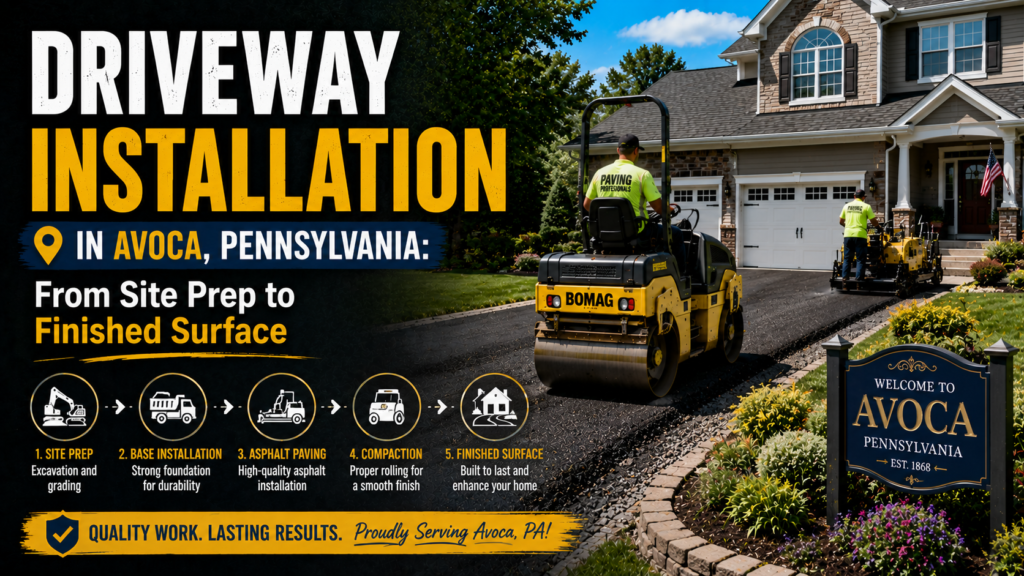
Installing a new driveway in Avoca, Pennsylvania is more involved than most property owners initially expect. What appears at completion as a simple, smooth black surface is actually the visible result of a carefully sequenced multi-phase process one in which the quality of each step determines the durability, drainage, and longevity of the finished product. In Northeastern Pennsylvania, where freeze-thaw cycling and harsh winters test every pavement system, a properly installed driveway is a genuine asset. An improperly installed one becomes an ongoing liability within a few seasons.
New Installation vs. Replacement: Understanding the Difference
Driveway Installation Avoca can refer to two different scenarios, each with its own scope and considerations:
- New installation on a previously unpaved surface: The driveway area has not been paved before, or the previous surface was gravel. This requires full sub-grade preparation from raw ground.
- Replacement of an existing paved driveway: The existing asphalt (or concrete) has deteriorated to the point where resurfacing is not appropriate, and the entire structure must be removed and rebuilt from the base up.
In both cases, the fundamental installation sequence is the same sub-grade preparation, base course installation, and surface course application. The difference is that replacement also involves removal and disposal of the existing material.
Phase 1: Site Preparation and Sub-Grade Work
The first phase of driveway installation in Avoca involves preparing the ground beneath where the driveway will be built. This is the most critical phase because the sub-grade the native soil beneath the pavement structure provides the ultimate support for everything above it.
Sub-grade preparation includes:
- Excavation to the required depth, removing existing material (asphalt, gravel, topsoil, organic material) to expose clean, stable sub-grade.
- Identification and correction of sub-grade problems: soft spots (typically caused by poor drainage, organic material, or inadequate bearing capacity) are dug out and replaced with compactable fill.
- Establishing the correct sub-grade grade the slope of the ground beneath the pavement to ensure positive drainage across the entire driveway area.
- Compacting the sub-grade with a vibratory plate compactor or roller to achieve the required density before base material is placed.
In Avoca’s climate, sub-grade preparation must also account for the frost line. While it is not practical to build the entire pavement structure below the frost line, minimizing the depth of moisture-susceptible material within the frost zone through good drainage and use of free-draining aggregate base material is critical to limiting frost heave damage.
Phase 2: Aggregate Base Course Installation
The aggregate base course is the load-distributing, drainage-providing structural layer installed between the sub-grade and the asphalt surface. For a residential driveway in Avoca, this layer is typically 4 to 6 inches of compacted quarry process aggregate (sometimes called crusher run or QP). For driveways that will see heavy vehicle use delivery trucks, large recreational vehicles, or agricultural equipment a deeper base may be appropriate.
Proper base installation involves:
- Delivering the aggregate in controlled quantities and spreading it to a consistent depth across the driveway area.
- Compacting in lifts layers of approximately 3 to 4 inches rather than placing the full depth and compacting once. Compaction in lifts produces more uniform density throughout the base thickness.
- Achieving the correct finished grade on the base surface the same positive drainage slopes established in the sub-grade before asphalt is applied.
A base that is correctly installed and compacted to the appropriate density provides the stable platform the asphalt surface requires to carry vehicle loads without cracking, rutting, or sinking.
Phase 3: Asphalt Surface Course Installation
With the base compacted and graded, the asphalt surface course is installed. Key steps in this phase:
- Hot mix asphalt is delivered at temperature from the plant. In Avoca, timing delivery to ensure the material arrives at the correct working temperature requires coordination between the contractor and the asphalt plant.
- The asphalt is spread to the specified depth typically 2 to 3 inches of compacted surface course for residential driveways using a mechanical paver or by skilled hand raking for tight areas.
- Joints between paving passes are carefully managed to ensure they bond properly and do not become crack initiation points.
- Steel drum rollers compact the fresh asphalt through multiple passes. Breakdown rolling immediately after placement, intermediate rolling while the material is still workable, and finish rolling to achieve the final surface texture and density all occur within the narrow temperature window when the asphalt is properly workable.
Garage Aprons, Transitions, and Edging
Quality driveway installation in Avoca pays careful attention to the transitions between the new driveway and existing surfaces the garage apron, the public sidewalk or curb cut, and the lawn or landscape edges. These transition points are among the first to show problems when installation is rushed or imprecise.
The garage apron the area between the garage floor slab and the driveway surface should be carefully graded to direct water away from the garage and to match the garage slab elevation without creating a hump that vehicle bumpers may contact. Curb transitions must be installed in compliance with any applicable municipal requirements for driveway approach slopes and ADA accessibility.
Permits and Pennsylvania One Call (811)
Driveway installation in Avoca that involves curb cuts or connections to public roads may require a permit from Luzerne County or the Borough of Avoca depending on the location. Before any excavation begins, Pennsylvania One Call (811) must be notified at least three business days in advance, so that utility companies can mark the locations of underground lines. This requirement applies to all excavation work regardless of scale.
Conclusion
Driveway installation in Avoca is a multi-phase engineering project that demands the same level of planning and execution discipline as any significant construction work. The phases of sub-grade preparation, base course installation, and asphalt surface placement are all equally important and cannot be shortcut without consequences that show up within a few Pennsylvania winters. Property owners who understand what quality installation looks like and insist on it invest in a driveway that will serve them reliably for decades.